
The Relationship Guide
Promise Traditions Through History: Claddagh, Handfasting and Love Locks
By The CustomLove Team · 5 min read ·
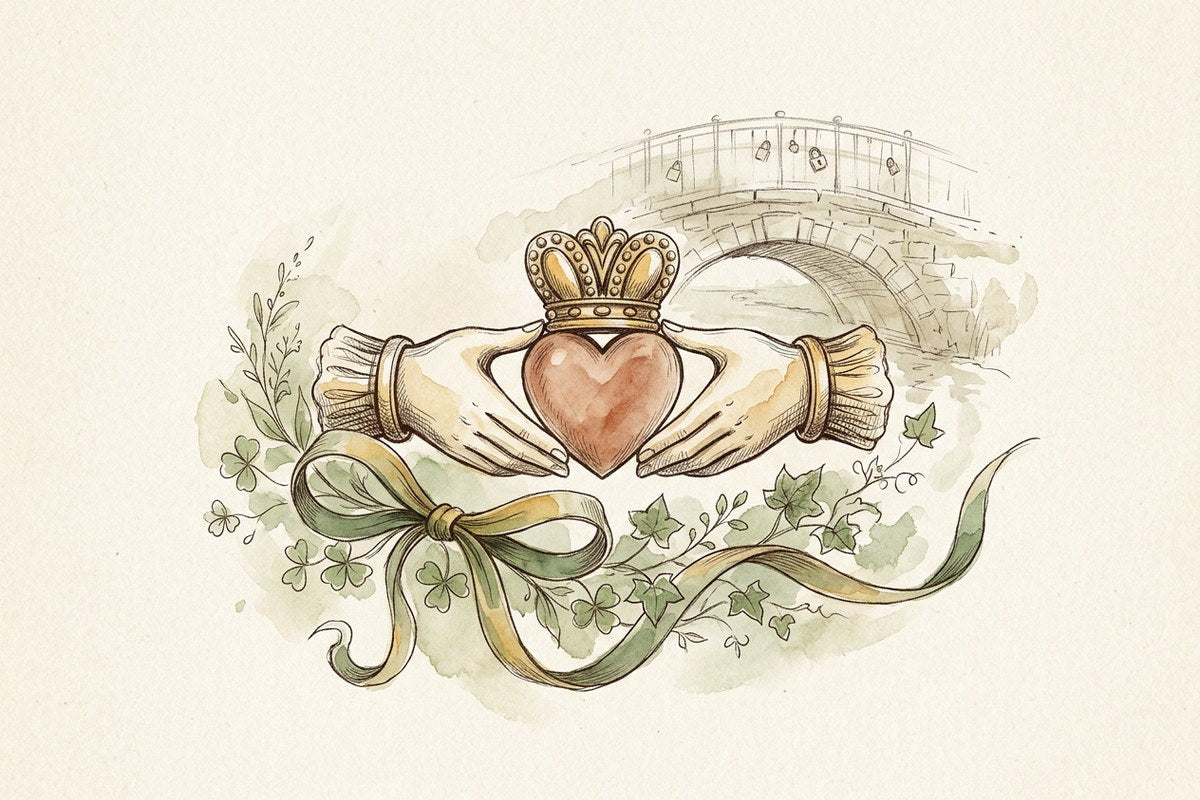
People have always wanted to make promises visible. A word can be forgotten; a ring, a knot or a lock is there every time you look. Here are three of the best-known promise traditions, with the history checked and the legends labelled as legends.
The claddagh ring (Galway, Ireland)
The claddagh comes from Claddagh, a small fishing village in Galway. Its modern form dates to the 17th century, and Galway goldsmiths have made it since at least around 1700 (Wikipedia: Claddagh ring).
What it means: two hands hold a heart topped with a crown. The hands stand for friendship, the heart for love, the crown for loyalty.
How it's worn (folk tradition, and it varies by family):
- Right hand, heart pointing out toward the fingertips: single.
- Right hand, heart pointing in toward the wrist: in a relationship.
- Left ring finger, heart pointing out: engaged.
- Left ring finger, heart pointing in: married.
History or legend? The ring is usually credited to Richard Joyce, a Galway silversmith around 1700, and his initials appear on one of the earliest surviving claddagh rings. The romantic story that he was captured by pirates, enslaved for fourteen years and came home with the design is legend.
Handfasting (England and Scotland)
Today "handfasting" usually means a ribbon tied around a couple's joined hands during a wedding. The history is different, and more interesting (Wikipedia: Handfasting):
- In medieval and early modern England, handfasting was a binding betrothal: a couple publicly agreed to marry, often about a month before the church wedding. It faded after England's Marriage Act of 1753.
- The idea of an ancient, pre-Christian ribbon-binding rite appears to be a modern invention. The ribbon ceremony grew out of neopagan practice from the late 1960s, and the version where guests add ribbons dates from around 2005.
Which doesn't make the ribbon less meaningful. It just means the meaning comes from the two people doing it, not from its age.
Love locks (Serbia, Rome, Paris)
A love lock is a padlock fixed to a bridge or railing, often with names written on it, and the key thrown away (Wikipedia: Love lock).
- One origin story comes from Vrnjačka Banja, a spa town in Serbia, around the First World War: a schoolteacher named Nada lost her fiancé to another woman, and young women later began fixing padlocks to the bridge where the couple used to meet.
- In Rome, the padlocks on the Ponte Milvio are linked to Federico Moccia's 2006 novel and its 2007 film.
- In Paris, the locks on the Pont des Arts became so heavy that part of the bridge's parapet collapsed in May 2014. The city removed the locks on 1 June 2015.
The Paris story is a good reminder that a promise doesn't have to be heavy to hold.
What all three have in common
Each tradition does the same three things:
- It's done on purpose, at a moment. An engagement, a visit, a decision.
- It's done together, or in front of people who matter.
- It leaves something visible behind.
Researchers who study family life draw the same line between routine and ritual: a ritual is what an act means to the people doing it (Fiese and colleagues, 2002). The age of the tradition matters much less than that.
Linda and David, from our story cast, have been married 34 years in Tucson. Their promise tradition is the least historic of all: every anniversary they reread their wedding vows out loud at the kitchen table, then argue cheerfully about who forgot the words in 1992.
If you'd like a modern version you make together, our Permanent Bracelet Kit for Couples is a promise you close on each other's wrists: two matching bracelets, pliers and cutters in the box, and a clasp designed to stay closed once it's secured. Something visible, done on purpose, together.
Questions people ask
What does a claddagh ring mean?
The two hands stand for friendship, the heart for love and the crown for loyalty. The ring comes from Claddagh, a fishing village in Galway, Ireland.
How do you wear a claddagh ring?
By folk tradition: right hand with the heart pointing out means single, pointing in means in a relationship; left ring finger pointing out means engaged, pointing in means married. Customs vary.
Is handfasting an ancient Celtic ritual?
Not as it's usually described. Historically, handfasting in England was a binding betrothal before a church wedding. The ribbon-tying ceremony is a modern practice, from the late 1960s onward.
Why were love locks removed from the Pont des Arts?
Their weight was blamed for the collapse of part of the bridge's parapet in May 2014, and Paris removed the locks on 1 June 2015.
Sources and further reading
About Love & Advice. We're not therapists. We're a small team who make gifts for people in love, and we've listened to a lot of love stories. Nothing here is medical, psychological or legal advice; if something you're carrying feels heavy, please talk to someone trained to help. Have a question for Dear CustomLove? Ask us anonymously.


